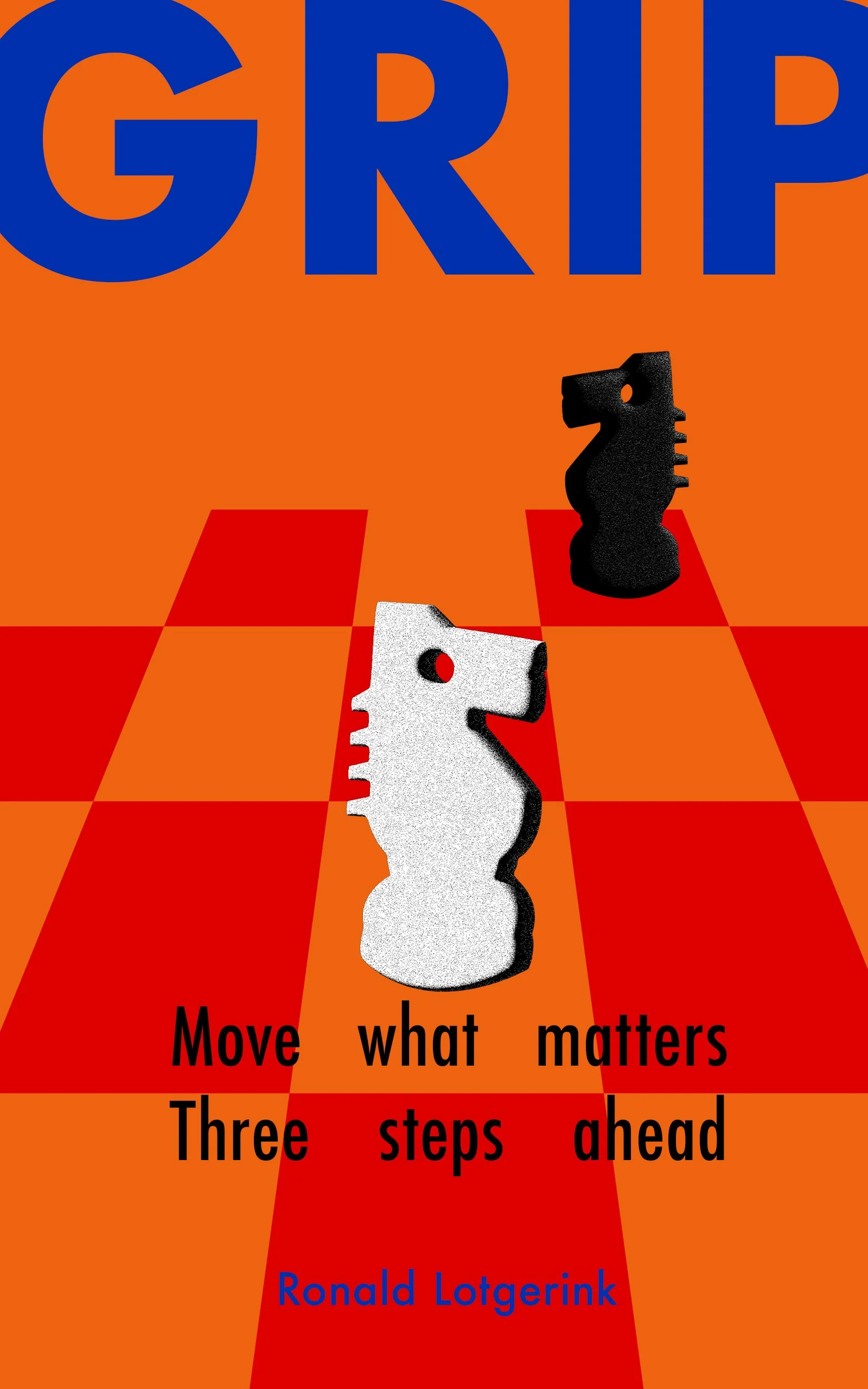
GRIP
The Decision Framework for Leaders Who Can't Afford to React Late
Most frameworks tell you how to analyze. GRIP tells you what to look for before the analysis is obvious — and what to do once you've found it.
GRIP is built around one observation: leaders don't fail because they lack information. They fail because they carry too many undifferentiated tensions without a governed protocol for deciding which ones demand action, which can be held, and which should never have been picked up in the first place.
The GRIP triage protocol resolves that problem. Five modes:
DROP — This tension doesn't belong to you. It costs you every day you carry it. Release it.
ACCEPT — The constraint is real. It isn't going away. Stop trying to solve it and work within it.
REFRAME — Same facts, different meaning. The tension dissolves when the frame shifts.
CONTAIN — Real problem, wrong moment. Manage it without solving it. Hold the line until the conditions change.
SOLVE — This one demands full commitment. Allocate fully or don't allocate at all.
GRIP has been tested in geopolitical signal analysis, market positioning, board-level strategy, and organizational crisis response. It works because it treats uncertainty as signal-bearing — not as something to wait out.
First book in the Three Steps Ahead series.
Published June 2026 · Paperback and Kindle · ISBN 9789083707808."
COMING NEXT
THE DECISION OWNER
How Leaders Use AI Without Outsourcing Judgment, Meaning, or Accountability
The second book in the Three Steps Ahead series. In development.
THE THREE STEPS AHEAD SERIES
Book Core question
GRIP Which tensions demand action — and which are costing you every day you carry them?
THE DECISION OWNER An AI recommendation becomes an organizational action. The result fails. Everyone participated, but nobody truly owned the decision. How Leaders Use AI Without Outsourcing Judgment, Meaning, or Accountability
GRIP — Sources Per Chapter
Chapter 1 — When Strategy Stopped Working
Hurricane Katrina (August 29, 2005)
National Hurricane Center advisory record (public)
U.S. House of Representatives, Select Bipartisan Committee to Investigate the Preparation for and Response to Hurricane Katrina. A Failure of Initiative (2006). Washington, D.C.: U.S. Government Printing Office.
Oatly
Nasdaq IPO prospectus (May 2021; ticker: OTLY)
Shareholder lawsuit alleging inflated sustainability claims — settled for $9.25 million (public court record)
Executive public statements re: "doom-and-gloom" climate language dampening demand (press reporting / earnings calls)
Chapter 2 — The Part That Breaks Is The Part You Need Most
UK Post Office Horizon scandal (referenced briefly; primary treatment in Ch. 17)
See Chapter 17 for full source list
Hurricane Katrina / Oatly — see Chapter 1
Chapter 3 — Signals Everywhere, Sense Nowhere
Global datasphere volume figures
IDC (International Data Corporation): Global DataSphere estimates — 45 zettabytes (2019); ~175 zettabytes (2025)
KOF Globalisation Index
KOF Swiss Economic Institute. KOF Globalisation Index (annual). ETH Zurich.
Greenpeace vs. Nestlé — palm oil campaign
Greenpeace International campaign (2010): Have a Break? (Kit Kat / palm oil) — public record;
Campaign reached global media within weeks of launch from a single allegation in Indonesia
Generative AI investment figures
$57 billion (2024), $87 billion (2025), projected >$600 billion (2026) (Bloomberg Intelligence / PitchBook / Dealroom )
Chapter 4 — Speed Without Governance
NIST AI Risk Management Framework
National Institute of Standards and Technology. AI Risk Management Framework (AI RMF 1.0). January 2023. NIST AI 600-1.
EU AI Act
European Parliament and Council of the EU. Regulation (EU) 2024/1689 on Artificial Intelligence (AI Act). Official Journal of the European Union, July 12, 2024. In force: August 1, 2024; major provisions applicable: August 2, 2026.
Oatly / Katrina — see earlier chapters
Chapter 5 — Tension: The Smallest Steerable Unit
Oatly — three named tensions (2021–2023)
Growth story vs. cash reality: S-1 / earnings releases (public)
Mission narrative vs. consumer fatigue: public commentary on brand sentiment, executive statements
Complexity vs. focus: company public statements and press reporting
No additional external sources cited in this chapter.
Chapter 6 — From Discomfort to Posture
Oatly (brief reference) — see Chapter 1
Chapter 7 — Meaning Is the Control Surface
Oatly — detailed case
Nasdaq IPO (May 2021; valuation ~$10 billion)
Short-seller report accusing cherry-picking of sustainability data (2021; report by Spruce Point Capital Management)
Greenwashing lawsuit settled for $9.25 million
Sales forecasts slashed by $90 million
Stock decline from peak: ~97% (from ~$10 billion to ~$270 million market cap by early 2025)
Celebrity investor participation (Oprah Winfrey, Jay-Z): public record / IPO prospectus
Chapter 8 — ABTA: The Atomic Narrative
Space Shuttle Columbia disaster (February 1, 2003)
Columbia Accident Investigation Board (CAIB). Columbia Accident Investigation Board Report. Vol. I. Washington, D.C.: NASA / GPO, August 2003.
Frank Daniel
Frank Daniel, 1986 speech — Columbia University / USC film programmes.
Trey Parker
6 Days to Air: The Making of South Park (2011). Comedy Central documentary. (Trey Parker describes the "but/therefore" principle)
Randy Olson
Olson, Randy. Houston, We Have a Narrative: Why Science Needs Story. University of Chicago Press, 2015.
Aristotle
Aristotle. Poetics. (Classical reference; any scholarly edition)
NASA, CDC, World Bank — cited as organizations where Olson's ABT template was applied;
Chapter 10 — COMMIT: Promising Reality
Boeing 737 MAX
Lion Air Flight 610: October 29, 2018 — 189 fatalities (Java Sea)
Ethiopian Airlines Flight 302: March 10, 2019 — 157 fatalities
Boeing internal documents: employee communications re: downplaying MCAS (released via congressional investigation)
Simulator test result (2012): MCAS failure classified as "catastrophic" under FAA terminology — Boeing did not report it
U.S. Congress, Senate Committee on Commerce, Science, and Transportation. The Design, Development, and Certification of the Boeing 737 MAX. December 2020.
Economic damage: >$18 billion; 737 MAX grounded ~21 months; CEO fired
Congressional finding: certification process "grossly insufficient"; no board safety committee
FAA findings: public record (various)
Johnson & Johnson — Tylenol crisis (1982)
7 deaths, Chicago area, potassium cyanide tampering — public record / FBI investigation
CEO James Burke — nationwide voluntary recall of 31 million bottles (>$100 million, 1982 dollars)
FDA: did not mandate the recall (public record)
J&J Credo (1943): public document, available at jnj.com
Market share recovery within 12 months: public record / press reporting
Tamper-evident packaging: became FDA-mandated industry standard post-crisis
Chapter 11 — SENSE: Seeing Early Without Drowning
Equifax data breach (2017) (primary treatment in Ch. 16 — see below)
Apache Struts vulnerability disclosed and patched: March 7, 2017
US-CERT notification to Equifax: March 8, 2017
Broken scan: March 15, 2017
Boeing 737 MAX — see Chapter 10
Flint, Michigan — see Chapter 18
Deepwater Horizon — see Chapter 15
Chapter 12 — TENSION: Admitting the Gap
Deepwater Horizon — Macondo well pressure tests
Abnormal pressure test results on day of blowout; "bladder effect" misinterpretation — documented in National Commission report (see Ch. 15)
Boeing 737 MAX / Flint — see earlier chapters
Chapter 13 — SOLVE: Designing One Intervention
Chipotle food safety crisis (2015–2016)
E. coli, norovirus, Salmonella outbreaks across 11+ states within 12 months
CDC investigation reports (various, 2015–2016) — specific report numbers to be identified
Binding constraint: fresh high-risk ingredients prepared at restaurant level with no centralised pathogen kill step
Deepwater Horizon — tradeoff never written down — see Chapter 15
Flint — "cost-saving water switch" reframe — see Chapter 18
Chapter 14 — DEPLOY: Four Weeks or Kill It
Oatly (2021 IPO deployment context) — see Chapters 1 & 7
Hurricane Katrina / FEMA
FEMA response record — see Ch. 1 congressional investigation
Inventory-vs-delivery failure referenced
Chapter 15 — Ownership Beats Consensus
Deepwater Horizon (April 20, 2010)
11 workers killed; ~4.9 million barrels spilled; 87 days to cap
Operators: BP (well operator), Transocean (rig owner), Halliburton (cement contractor)
Tony Hayward public statement: "This wasn't our accident. This was a drilling rig operated by another company." (press reporting — multiple outlets)
Halliburton internal simulations showing centralisers made little difference — employees destroyed evidence (DOJ / court record)
National Commission on the BP Deepwater Horizon Oil Spill and Offshore Drilling. Deep Water: The Gulf Oil Disaster and the Future of Offshore Drilling. January 2011. Washington, D.C.: GPO.
U.S. Coast Guard / Bureau of Ocean Energy Management investigation findings
Federal court judgment: 67% BP, 30% Transocean, 3% Halliburton (U.S. District Court, Eastern District of Louisiana — In re: Oil Spill by the Oil Rig "Deepwater Horizon")
BP: >$20 billion in settlements; guilty plea to 11 counts of manslaughter
Transocean: $1.4 billion settlement; Halliburton: $1.1 billion settlement
Greenpeace Arctic Sunrise (September 2013)
Protest at Gazprom's Prirazlomnaya platform, Pechora Sea
Russian authorities: piracy charges (15-year maximum), 2-month detention in Murmansk
International Tribunal for the Law of the Sea (ITLOS): The "Arctic Sunrise" Case (Kingdom of the Netherlands v. Russian Federation), Provisional Measures Order, November 22, 2013 — ruled Russia violated international law
Dutch government diplomatic intervention: public record
Chapter 16 — Proof Beats Persuasion
Equifax breach (2017) — full treatment
Apache Software Foundation: Struts vulnerability disclosed and patch released, March 7, 2017
U.S. Department of Homeland Security (US-CERT): notification to Equifax, March 8, 2017
Internal Equifax email to administrators: March 9, 2017
Equifax security team scan (broken): March 15, 2017
78 days of undetected attacker access
Personal data of 147 million Americans extracted
Total cost: $1.38 billion in settlements and remediation
U.S. Federal Trade Commission, Consumer Financial Protection Bureau, and state attorneys general settlements — public record
Deepwater Horizon — cement stability tests
February 2010: four stability tests on Halliburton foam slurry; 3 of 4 showed instability — documented in National Commission report (see Ch. 15)
Negative-pressure test "bladder effect" misinterpretation on day of blowout
BP total cost: >$65 billion (combined settlements, remediation, fines)
Chapter 17 — The PATCH Habit
UK Post Office Horizon scandal (1999–2024)
Horizon accounting system deployed 1999 across ~11,000 branches; developer: Fujitsu
Fujitsu knew about bugs as early as 1999 (internal documents, disclosed in public inquiry)
900+ sub-postmasters convicted of theft, fraud, or false accounting
At least 13 suicides attributed to the wrongful prosecutions
Compensation: exceeded £594 million by 2025, with claims still rising
2024 mass exonerations: Post Office (Horizon System) Offences Act 2024 (UK Parliament)
Sir Wyn Williams Inquiry (ongoing as of 2025): Horizon IT Inquiry — public hearings and interim reports
Key documents: Post Office internal legal documents; Fujitsu bug reports (released in inquiry)
Samsung Galaxy Note7 (2016–2017)
Initial recall: September 2016 — 2.5 million devices
Southwest Airlines incident: October 6, 2016 — replacement Note7 caught fire
Samsung internal investigation published: January 2017 — confirmed both suppliers' batteries had different defects caused by design-level pressure on battery geometry
Estimated loss: ~$17 billion; product permanently discontinued
Source: Samsung Electronics press release (January 22, 2017) + press reporting
Chapter 18 — Human Failure Modes (And the Counters)
Flint, Michigan water crisis
April 2014: state emergency managers switched Flint's water supply to Flint River to save ~$5 million
General Motors publicly stopped using Flint water due to engine corrosion (October 2014)
Dr. Mona Hanna-Attisha (Hurley Medical Center): published peer-reviewed data showing children's blood-lead levels had doubled — initially dismissed by state officials
Hanna-Attisha, Mona, et al. "Elevated Blood Lead Levels in Children Associated With the Flint Drinking Water Crisis." American Journal of Public Health 106, no. 2 (2016): 283–290.
~100,000 residents exposed between April 2014 and October 2015
12 deaths linked to Legionnaires' disease outbreak
State of Michigan: $626 million settlement (2021) — public record
Anti-corrosive treatment (orthophosphate) would have cost ~$140/day — documented in state and federal investigations
U.S. EPA and Michigan MDEQ investigation records (public)
Chapter 19 — Where AI Belongs in GRIP
Maersk / NotPetya cyberattack (June 27, 2017)
NotPetya wiper entered via Ukrainian tax software (M.E.Doc) update
4,000 servers, 45,000 PCs, 1,200 business applications wiped; all Active Directory instances destroyed
76 port terminals reverted to paper manifests and WhatsApp
Clean domain controller backup found in Ghana office — physically flown to London
Volume dropped only ~20%; estimated losses: $250–300 million
Infrastructure rebuild compressed from 6 months to 10 days
Sources: Maersk public statements; Wired magazine ("The Untold Story of NotPetya," August 2018 — Sandvik, Runa / Andy Greenberg)
EU AI Act — see Chapter 4; Articles 14 and 26 specifically
Chapter 20 — Why Humans Still Own the Damage
Airbnb / COVID-19 — March 2020
Brian Chesky's extenuating circumstances policy decision: full refunds for bookings before March 14, check-ins through May 31
Chesky letter to hosts: March 30, 2020 (public) — acknowledged communicating to guests without consulting hosts "like partners should"
$250 million host compensation fund; $10 million superhost relief fund — Airbnb press release
Host lawsuits and arbitration claims: press reporting (various)
All above: public record / press reporting
EU AI Act — Articles 14 and 26; penalties: €35 million or 7% global turnover — see Chapter 4
Chapter 21 — A Full GRIP Run Under Fire (WeWork)
WeWork S-1 and IPO collapse (2019)
S-1 prospectus filed with SEC: August 14, 2019 (350 pages; 150 uses of "community"; mission to "elevate the world's consciousness")
Cumulative losses 2016–H1 2019: $4.2 billion on $4.7 billion revenue
Long-term lease obligations: $17.9 billion
Governance: founder Adam Neumann held concentrated voting power
Related-party: company paid founder ~$5.9 million to license "We" trademark — disclosed in S-1
IPO target valuation: $47 billion → $20–30B → ~$10B within weeks of S-1 publication
CEO Adam Neumann stepped down: September 24, 2019
S-1 formally withdrawn: September 30, 2019
SoftBank rescue package: ~$9.5 billion; 80% stake; company valued at $8 billion (announced October 23, 2019)
WeWork Chapter 11 bankruptcy: November 2023
Sanford C. Bernstein analyst report (cited by Fortune): ~$700 million/quarter burn rate; risk of running out of cash by early 2020
Location count: expanded from 485 to 528 in a single quarter (2019); 169 more planned — per S-1
Expenses: 190% of revenue (H1 2019) — per S-1
Primary sources cited in text:
WeWork SEC filings (S-1 and subsequent) — SEC EDGAR
SoftBank public statements
CNBC, CNN, Bloomberg, Fortune, Reuters reporting
Chapter 22 — Containment, Coalitions, and Face-Saving (Microsoft/Nokia)
Microsoft / Nokia acquisition writeoff (July 2015)
$7.6 billion impairment charge — Microsoft SEC filing (10-K / 8-K, fiscal year 2015)
~7,800 layoffs in phone hardware + ~12,500 from previous year
Source: Microsoft's SEC filing and Computerworld reporting
Satya Nadella voted against Nokia deal while on Ballmer's leadership team
Nadella, Satya. Hit Refresh: The Quest to Rediscover Microsoft's Soul and Imagine a Better Future for Everyone. HarperBusiness, 2017.
Nadella became CEO: February 4, 2014
Nokia acquisition already closed at that point
Within 5 years: Microsoft share price tripled — Fortune reporting (cited in text)
Subsequent acquisitions: LinkedIn ($26.2B, 2016); GitHub ($7.5B, 2018) — public record
Chapter 23 — When You're Still Wrong (Intel Pentium)
Intel Pentium floating-point bug (1994)
Thomas Nicely (Professor of Mathematics, Lynchburg College): discovered flaw — published finding November 1994
Intel's own analysis: affected ~1 in 9 billion random division operations
IBM: halted all Pentium-based computer shipments (December 1994)
CNN segment; New York Times front-page story — November/December 1994
Intel reversed course: December 20, 1994 — no-questions-asked chip replacement
$475 million pre-tax charge — Intel Annual Report 1994
Chapters 24–26 — Ritual, Scaling, Moral Act
No new primary sources. These chapters apply the GRIP framework and reference cases established in earlier chapters:
Boeing, WeWork, Flint, Katrina, Deepwater Horizon, Microsoft/Nokia
Cross-Chapter Sources (Referenced Multiple Times)
Source Chapters Hurricane Katrina — "A Failure of Initiative" congressional report 1, 2, 4, 14, 26 Oatly SEC filings / press record 1, 4, 5, 6, 7, 14 Boeing 737 MAX — congressional investigation, internal documents 8, 10, 11, 12, 26 Post Office Horizon — UK public inquiry, Post Office Act 2024 2, 17 Deepwater Horizon — National Commission report, court record 11, 12, 13, 15, 16, 26 Flint water crisis — Hanna-Attisha study, $626M settlement 11, 12, 13, 18, 26 Equifax breach — FTC / CFPB / state settlements 11, 16 WeWork S-1 — SEC filing 21, 26 EU AI Act — Regulation (EU) 2024/1689 4, 19, 20
Books
Filters
No results found
No results match your search. Try removing a few filters.